By Seth Norman Greenberg | Vice President, Pavillion Agency
One of the most common conversations I have with experienced household professionals is about how to leave a current position well.
They’re not miserable. They’re not dealing with a crisis. They’ve simply reached a point where they’re ready for something better — and they’re worried about how to navigate the transition without damaging a relationship that has, in many cases, been years in the making.
This is a legitimate concern. The household staffing world is small. Your reputation follows you. And a departure handled poorly can affect not just your reference, but the way your name is discussed in circles that matter.
Here’s how to do it right.
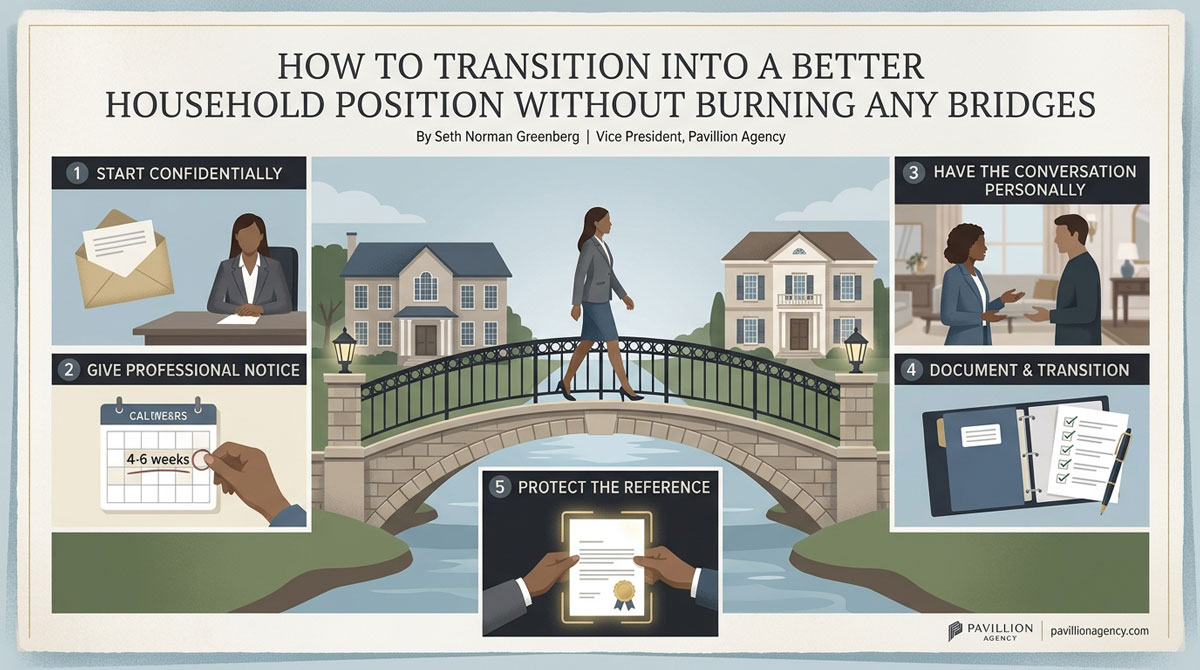
Start Your Search Confidentially
Before you say a word to your current employer, talk to your placement agency. This is exactly what we’re here for.
A confidential search allows you to understand your market options without creating unnecessary disruption in your current household. It gives you the information you need to make a clear-eyed decision. And it ensures that if the right opportunity presents itself, you’re in a position to move thoughtfully — not reactively.
At Pavillion, confidentiality is not an add-on. It’s how we operate. Families and candidates both trust us with sensitive information. That trust is the foundation of everything we do.
Give Real, Professional Notice
The question I hear most often is: how much notice should I give?
My consistent answer: more than the minimum, if the relationship warrants it.
The employment agreement will specify a notice period, often two to four weeks. But in a household where you’ve been employed for several years, a longer transition — four to six weeks, if you can manage it — signals that you value the relationship and take your professional obligations seriously.
This is especially important in households with children, where continuity matters. A nanny or household manager who gives adequate notice, helps with the transition, and leaves with grace is doing a service not just to the family, but to whoever comes after them.
And it protects your reference. Principals remember how people leave, sometimes more vividly than how they arrived.
Have the Conversation Personally
Do not leave by text. Do not leave by email. Do not leave through a third party.
Have the conversation in person, at a time when the principals are not stressed or distracted. Be prepared, be calm, and be kind. You do not owe a lengthy explanation — but you owe a real one.
“I’ve deeply valued my time here, and this has been a genuinely hard decision. I’ve been offered an opportunity that aligns with where I want to go in my career, and I’ve decided to take it.”
That’s enough. You don’t need to justify your decision. You just need to deliver it with respect.
Document and Transition Thoroughly
One of the most professional things you can do in a departure is leave the household better prepared for your absence than it was before.
This means documenting: vendor contacts, household routines, preferences of the principal, schedules, inventory locations, and anything else that lives in your institutional knowledge. Write it down. Leave it organized.
A transition document is not a burden. It’s a final act of professionalism that families rarely forget — and almost always mention when they’re giving references.
Protect the Reference
Your reference from this position is an asset. Treat it accordingly.
Before you leave, ask directly whether your employer would be comfortable serving as a professional reference. Clarify what they’re comfortable saying and to whom. In some cases, written references are more appropriate than phone calls — and they offer you more control over how your tenure is characterized.
If the relationship has been good, this conversation will be straightforward. If there has been friction, it’s still worth having — a neutral reference is better than an uncertain one, and most principals, when approached respectfully, are willing to be fair.
Leaving well is a skill. And in a field where your reputation is your most valuable professional asset, it is one worth developing with as much intentionality as anything else you do.
If you’re ready to begin a confidential search, I’m here. Reach me at seth@pavillionagency.com or visit pavillionagency.com.
💬 Have you navigated a difficult departure well — or been in a situation where you wished you’d handled it differently? What would you advise someone facing that decision now?