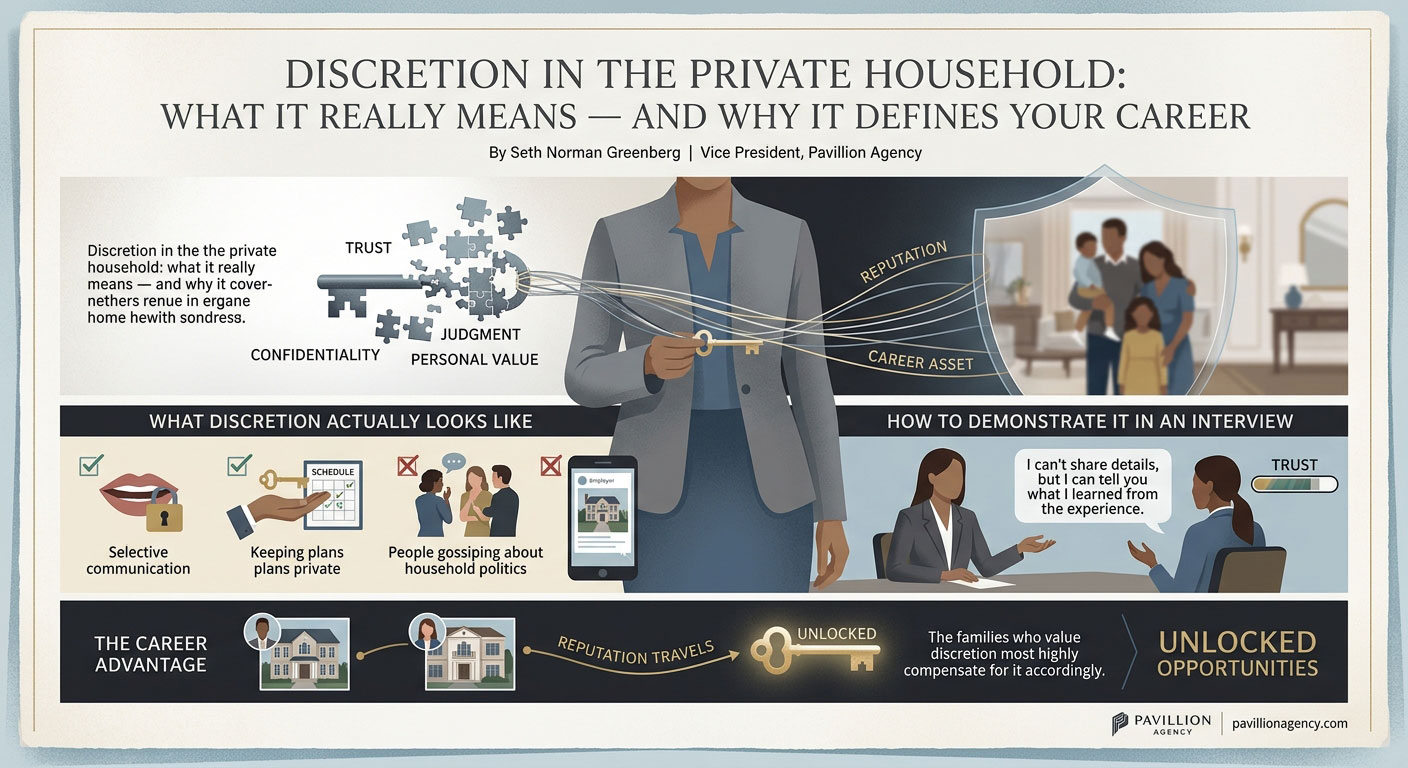
By Seth Norman Greenberg | Vice President, Pavillion Agency
Of everything I evaluate in a household professional candidate, discretion may be the most important — and the hardest to measure in an interview.
It’s easy to say “I understand the importance of confidentiality.” Every candidate does. What I’m actually trying to assess is something more nuanced: whether discretion is a deep personal value for this individual, or a professional rule they follow when reminded.
The difference matters enormously in a private household.
What Discretion Actually Looks Like in Practice
Discretion is not just about not talking to the press, or not sharing photos of a principal’s home on social media. Those are the obvious cases. Discretion, in day-to-day household service, is far more granular.
It means not discussing a family’s schedule, travel plans, or routines — even casually, even with people who seem harmless. It means not speaking about employer disagreements, family tensions, or financial matters with other household staff. It means understanding that the information you encounter in the course of your work is not yours to interpret or relay, regardless of context.
It also means something subtler: not allowing yourself to become a vehicle for household politics. In homes with multiple staff, alliances form. Complaints circulate. A household professional who participates in that dynamic — even passively — compromises their own standing and contributes to an environment that eventually becomes difficult for everyone.
The most trusted professionals I have ever placed are people who are almost unusually contained. Not cold — they are warm, engaged, and genuinely present. But they hold information with a particular kind of care that principals recognize instantly, even if they can’t always name it.
Why Discretion Is a Career Asset
In the world of fine household staffing, the network of exceptional principals is smaller than it appears. High-net-worth families in New York, the Hamptons, Palm Beach, and similar markets know each other. They talk. They share recommendations. And when a household professional has a reputation for discretion, that reputation travels.
I have seen this firsthand: a candidate with a strong reference from one respected family enters a completely different tier of opportunity. Not because they suddenly became more skilled — but because trust, once established and communicated, changes everything.
Conversely, I have seen promising careers stall when word circulated that a professional had been careless with information. The household staffing world is small enough that this matters.
How to Demonstrate Discretion in an Interview
This is one of the most common questions candidates ask me when I’m preparing them for a placement interview. How do you show something that is, by its nature, invisible?
You show it by how you speak about your previous employers.
When I ask candidates about past positions, I listen for whether they speak with respect about the families they’ve served — even those that were difficult. A candidate who says “I can’t share details about that household, but I can tell you what I learned from the experience” is demonstrating the exact quality I’m looking for. A candidate who provides a detailed account of a principal’s behavior, regardless of how sympathetic the story is, is showing me exactly the opposite.
You also demonstrate it in what you don’t ask. Candidates who probe for information about a potential employer’s finances, personal relationships, or household conflicts during an interview — even out of curiosity — raise questions about their professional judgment.
Discretion is not silence. It’s selective, appropriate, principled communication. And it can absolutely be shown in an interview, to those who know what to look for.
What It Means for the Future of Your Career
The families who value discretion most highly — and compensate for it accordingly — are the ones who have been burned before. They have had staff who talked. They have seen private information circulate in ways that were painful or damaging. And they have learned, sometimes at significant cost, what they actually need in a household professional.
When you can demonstrate, through your references and your conduct in the interview, that you are that kind of professional, the opportunity that opens to you is qualitatively different.
At Pavillion, we work with families who require the highest level of discretion — and we represent candidates who meet that standard. If you’re a professional for whom discretion is genuinely a core value, I’d very much like to speak with you.
Reach me at seth@pavillionagency.com.
💬 How do you approach the discretion standard in your own professional life? Is there a principle or practice that guides you? I’d love to hear how other household professionals think about this.